
GHK-Cu: 50 Years of Peer-Reviewed Science. One Sublingual Strip. Younger Skin — From the Inside Out
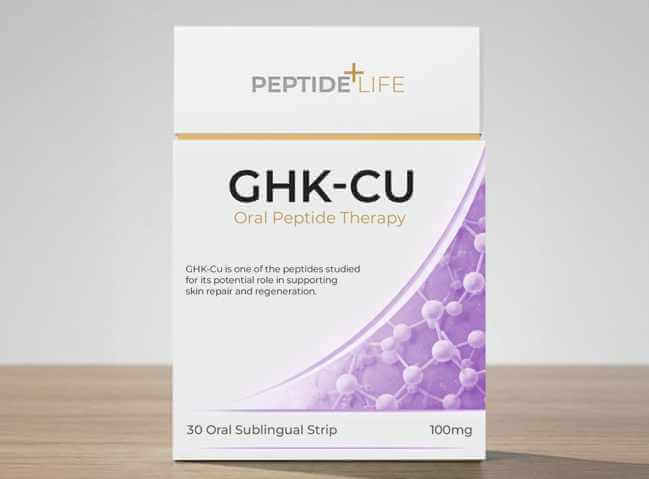
GHK-Cu is one of the most powerful anti-ageing molecules ever discovered — a naturally occurring copper peptide found in your own blood that activates over 4,000 genes responsible for collagen production, DNA repair, and the reversal of sun damage.
Backed by 50 years of peer-reviewed science, it does not mask the signs of ageing — it signals your cells to reverse them at the biological level. Every decade after 20, your skin loses collagen, elastin, and the regenerative power that kept it firm, smooth, and youthful. GHK-Cu gives it back.
The Anti-Ageing Secret Your Skin Has Been Producing Since Birth — Now Delivered Directly Into Your Bloodstream
GHK-Cu sublingual strips are the most exciting breakthrough in anti-ageing skincare in a generation. By dissolving under your tongue, they deliver GHK-Cu directly into your bloodstream — bypassing the skin barrier that blocks up to 85% of every serum and cream ever applied to your face.
The result is systemic delivery to every skin cell simultaneously, from the inside out, the way biology was designed to work. For men and women who are serious about reversing facial lines, wrinkles, sagging, and sun damage — not covering them up, not temporarily filling them, but genuinely reversing them at the cellular level — the GHK-Cu sublingual strip is simply unlike anything that has existed before.
The Science of Facial Ageing — And How to Reverse It From the Inside OutWhy Your Face Ages — The Biological Truth Most Skincare Brands Don’t Tell You
Your skin does not age because of what you put on it. It ages because of what stops happening inside it.
From your mid-20s onwards, a cascade of biological processes begins to slow, stop, or reverse. By the time you reach your 40s, 50s, and 60s, the cumulative effect of these changes is written visibly on your face — in every line, wrinkle, area of sagging, and patch of sun-damaged skin.
Understanding what is actually happening at a cellular level is the first step to reversing it.
Table of Contents
What Happens to Your Skin Decade by Decade
Your 30s — The Silent Beginning
- Collagen production slows — your skin produces approximately 1% less collagen every year from age 20, meaning by 35 you have already lost 15% of your structural scaffolding
- Cell turnover slows — skin cells take longer to regenerate; the fresh, luminous quality of younger skin begins to dull
- First dynamic wrinkles appear — expression lines from smiling, squinting, and frowning begin to etch permanently into the skin at crow’s feet and frown lines
- Hyaluronic acid production declines — the molecule responsible for skin hydration and plumpness begins to reduce, causing subtle volume loss
Your 40s — The Acceleration
- Collagen and elastin fibres fragment — the structural network holding skin firm begins to break down, causing fine lines to deepen into wrinkles
- Fat pads redistribute — the subcutaneous fat that gives the face its youthful contour begins to shift downward, contributing to jowling and nasolabial fold deepening
- Oestrogen and testosterone decline — hormonal changes directly impair collagen synthesis, skin thickness, and the skin’s ability to retain moisture
- Skin barrier function weakens — the outer protective layer becomes less effective, increasing trans-epidermal water loss and sensitivity
Your 50s — The Compounding Effect
- Skin thickness reduces measurably — the dermis literally becomes thinner, making veins, bones, and tendons more visible and wrinkles appear deeper
- Sebaceous gland activity decreases — skin produces less natural oil, accelerating dryness and loss of surface radiance
- Gravity compounds collagen loss — reduced structural support means tissue begins to descend: jowls deepen, brows lower, and the jawline softens
- Cumulative UV damage becomes visible — decades of sun exposure manifest as hyperpigmentation, uneven texture, and accelerated wrinkling
Your 60s — The Structural Shift
- Bone resorption changes facial structure — the skull itself changes shape, reducing the bony support under the skin and contributing to hollowing in the temples, under-eye area, and cheeks
- Collagen levels reach approximately 50% of peak — by age 60 you have roughly half the collagen you had at 20
- Wound healing slows significantly — the skin’s ability to repair and regenerate falls to a fraction of its youthful capacity
- All previous factors compound simultaneously — the combined effect of hormonal decline, collagen loss, UV damage, and structural change produces the most visible acceleration of facial ageing
The Six Root Causes of Facial Ageing — Addressed by One Molecule
Facial ageing is not one problem. It is six problems operating simultaneously. What makes GHK-Cu extraordinary is that it addresses all six at the biological level — not cosmetically, but through genuine cellular reprogramming.
What Is GHK-Cu — The Science Behind the Molecule
GHK-Cu (Glycyl-L-Histidyl-L-Lysine Copper) is a naturally occurring tripeptide found in human blood plasma, saliva, and urine. First isolated in 1973 by Dr. Loren Pickart at the University of California, it has been continuously researched for over 50 years — with published studies now numbering in the hundreds.
What makes it unique among all anti-ageing compounds: it does not work through one mechanism. GHK-Cu has been shown to modulate the expression of over 4,000 human genes — a breadth of biological effect that no other skincare ingredient approaches.
In simple terms: GHK-Cu does not mask ageing. It signals your cells to behave as they did when you were younger.
“GHK-Cu acts as a biological signal that resets tissue to a more youthful, regenerative state.”
— Published review, PMC / National Institutes of Health
The Clinical Evidence — What The Trials Actually Show
These are not manufacturer claims. These are results from independent, peer-reviewed human clinical trials published in international journals.
Trial 1 — Facial Photoaging Study (41 women, 12 weeks)
A controlled trial using GHK-Cu eye and face cream found:
- Significantly reduced fine lines and wrinkles
- Improved skin density and firmness
- Increased skin thickness measured by ultrasound
- Results superior to both placebo and vitamin K cream
Trial 2 — Gene Expression Analysis (photoaged skin)
Skin biopsy analysis after 12-week GHK-Cu treatment found:
- 70% of UV-dysregulated genes normalised — meaning the genetic damage caused by sun exposure was partially reversed at the cellular level
- Increased dermal density and organised collagen fibre structure
Trial 3 — Clinical Measurement Study (split-face design)
Objective measurements before and after 12-week GHK-Cu treatment showed:
- 35% reduction in fine line depth
- 25% improvement in skin elasticity
- 25–40% increase in dermal density
- 4% increase in measurable skin thickness
Why Topical Serums Alone Are Not Enough — The Absorption Problem
This is the most important thing the skincare industry does not want you to know.
The skin barrier — specifically the stratum corneum — is one of the most effective biological barriers in the human body. Its entire evolutionary purpose is to keep things out. This means that even the best-formulated, highest-concentration GHK-Cu serum delivers only a fraction of its active ingredient to the dermal layer where collagen synthesis actually occurs.
Studies consistently show that topical peptide serums deliver approximately 10–15% relative bioavailability to dermal tissue. The majority sits on the skin surface or is washed away.
This is why injectable GHK-Cu — used in clinical settings — produces dramatically faster and more significant results than any topical product. The injection bypasses the barrier entirely.
The sublingual strip solves this problem for the first time in a consumer format.
The thin mucosal tissue under your tongue is highly vascularised — rich in blood vessels with no equivalent barrier to the skin. A molecule dissolved under the tongue enters the bloodstream directly, bypassing the skin barrier, bypassing first-pass liver metabolism, and reaching dermal fibroblasts through the bloodstream from below while your topical serum works from above.
Introducing the GHK-Cu Sublingual Strip
The World’s First Inside-Out Anti-Ageing Delivery System
While the world has been applying peptides to the surface of skin for decades, we have created the first product that delivers GHK-Cu through the one route the skin barrier cannot block — directly into your bloodstream through sublingual mucosal absorption.
The result: GHK-Cu reaches your dermal fibroblasts from below, travelling through your circulatory system to every skin cell in your face simultaneously — not just the areas you applied a serum to.
What Each Strip Contains
How to Use — The Simple Daily Protocol
Morning Strip
- Place one strip under your tongue — hold it flat against the floor of your mouth
- Do not swallow — hold for a minimum of 15 minutes, ideally 20
- Allow it to dissolve completely
- Follow with your GHK-Cu topical serum applied to cleansed skin
- Apply SPF on top — essential for protecting the collagen synthesis the strip is driving
Evening Strip
- Apply your topical serum to cleansed face first
- Place one strip under your tongue — hold for 15–20 minutes
- Most collagen synthesis occurs during sleep — the evening strip delivers GHK-Cu during the overnight repair window
The Complete Recommended Protocol
| Time | Action |
|---|---|
| Morning — before breakfast | 1 × sublingual strip held 15–20 minutes |
| Morning — after strip | Topical GHK-Cu serum applied to face and neck |
| Morning — last step | SPF 30–50 applied |
| Evening — after cleansing | Topical serum applied |
| Evening — during skincare | 1 × sublingual strip held 15–20 minutes |
| Cycle | 12 weeks on, 4 weeks off — allows tissue consolidation |
What Results to Expect — And When
Results build progressively. The first effects are at the cellular level — invisible but laying the foundation for visible improvement that compounds over 12 weeks.
How GHK-Cu Compares to Alternatives
| Treatment | Mechanism | Invasiveness | Result Quality | Price | Sun Sensitivity |
|---|---|---|---|---|---|
| GHK-Cu Sublingual Strip | Systemic + topical collagen activation | None | ⭐⭐⭐⭐ | £ | None |
| Topical retinol | Cell turnover acceleration | None | ⭐⭐⭐ | £ | ⚠️ High |
| Topical peptide serum only | Surface collagen signalling | None | ⭐⭐ | ££ | None |
| Botox | Muscle paralysis | Needles | ⭐⭐⭐ (expression lines only) | £££ | None |
| Dermal fillers | Volume replacement | Needles | ⭐⭐⭐ (volume only) | £££ | None |
| Clinical injectable GHK-Cu | Direct systemic delivery | Needles | ⭐⭐⭐⭐⭐ | ££££ | None |
| Laser resurfacing | Controlled skin damage | High | ⭐⭐⭐⭐ | ££££ | ⚠️ High |
Particularly Effective For — Sun Damage Reversal
For anyone who has spent years in high-UV climates — the Caribbean, Mediterranean, Australia, Southern US — GHK-Cu addresses the specific damage mechanisms that decades of sun exposure create.
UV radiation works through three distinct damage pathways. GHK-Cu blocks all three:
1. MMP Enzyme Activation
Every significant UV exposure activates matrix metalloproteinases — enzymes that literally destroy collagen and elastin. GHK-Cu suppresses MMP-1, MMP-3, and MMP-9 expression while increasing their natural inhibitors (TIMPs), stopping the ongoing collagen destruction that compounds year on year.
2. Oxidative Radical Damage
UV radiation generates reactive oxygen species that damage skin cell DNA, proteins, and membranes. GHK-Cu increases superoxide dismutase and catalase — the two primary enzymatic antioxidant defences in skin — and directly binds and neutralises the most toxic UV byproducts including 4-hydroxynonenal and malondialdehyde.
3. UV Gene Mutation Accumulation
Decades of UV exposure alter gene expression in skin cells — turning off repair genes and turning on ageing genes. GHK-Cu’s gene modulation activity normalises 70% of UV-dysregulated genes, partially reversing the genetic programme of photoageing at its source.
“GHK-Cu is the only topically applicable compound that works against UV damage at the genetic level rather than simply compensating for it.”
Unlike retinoids — the other evidence-based anti-ageing ingredient — GHK-Cu does not cause photosensitivity. It can be used morning and evening year-round in high-UV climates without any need for sun avoidance.
The Safety Profile — 50 Years of Evidence
GHK-Cu has been researched continuously since 1973. In over five decades of human and laboratory research:
- ✅ No serious adverse events reported in any published human clinical trial
- ✅ No lethal dose identified in toxicology studies
- ✅ No photosensitising effect — safe for use in all climates
- ✅ No drug interactions identified
- ✅ The copper content is trace-level — the GHK-peptide-copper bond regulates bioavailability, preventing copper accumulation
- ✅ Safe for all skin types — no irritation, no peeling, no sensitivity period
Frequently Asked Questions
How is this different from a copper peptide serum?
A serum applies GHK-Cu to the skin surface. The skin barrier blocks most of it from reaching the dermis. The sublingual strip delivers GHK-Cu through your bloodstream — reaching every dermal fibroblast in your face through circulation rather than trying to push molecules through a biological barrier designed to keep things out.
Do I still need a topical serum?
Yes — and the two work synergistically. The strip provides systemic delivery to all facial tissue. The topical serum provides a local concentration gradient at the skin surface. The two routes complement rather than replace each other.
When will I see results?
Most users notice a subtle improvement in skin texture and hydration at weeks 3–4. Measurable visible improvement in fine line depth typically appears at weeks 6–8. Full clinical results — corresponding to the published trial data — are achieved at 12 weeks of consistent use.
Is this suitable for men?
Entirely. Men experience the same collagen decline, UV damage, and structural ageing described above — and GHK-Cu’s mechanisms are equally effective regardless of sex.
Can I use it if I already use Botox or fillers?
Yes — GHK-Cu addresses different mechanisms (collagen structure, UV damage, skin quality) than Botox (muscle movement) or fillers (volume replacement). They are complementary rather than competing treatments.
The Bottom Line
Your face ages because of biology, not lifestyle choices you can simply undo. Collagen declines. UV damage accumulates. Cells lose energy. The genetic programme of regeneration slows.
Topical skincare — however well formulated — works at the surface of a barrier designed to keep active molecules out. Injectable treatments work but require clinic access, needles, and ongoing clinical costs.
The GHK-Cu Sublingual Strip is the first product to deliver the most comprehensively researched anti-ageing peptide in existence through the one route your skin barrier cannot block — directly into your bloodstream, reaching every skin cell in your face simultaneously, signalling the biological reset that 50 years of science confirms is possible.
All clinical data referenced in this document derives from peer-reviewed, independently published human trials. GHK-Cu has been studied continuously since 1973 with over 50 years of published safety and efficacy data.

